24/7 dispatch
4.7681 Google reviews
WreckMaster and I-TECC certified
Family-owned in Evergreen
(303) 674-0198
D&J Towing handles light-duty towing for the cars, SUVs, minivans and pickups people drive every day in the Colorado foothills and Denver metro. Before anything gets hooked, we match the loading method to your drivetrain and ground clearance, so an AWD crossover, a lowered coupe and a work pickup each ride the way their makers intended.
Every owner's manual has a towing section, and the drivetrain decides most of what it says. Choose the closest match to see which methods fit and what to tell dispatch. When the answer is a flatbed, our flatbed towing page covers that truck in detail.
General guidance only. Your owner's manual has the final word for your exact model, and dispatch confirms the method on the phone.
The engine drives the front wheels, so those are the ones to keep off the road. Many front-wheel-drive manuals allow a wheel-lift tow with the front raised and the rear wheels rolling. Towing backward with the front wheels down is the setup they warn against.
Here the rear wheels turn the driveshaft and transmission. Lift only the front and those wheels spin the driveline for the whole trip, which many manuals warn against. The rear axle goes up, dollies go under it, or the vehicle rides on a flatbed.
When every wheel is tied into the drivetrain, rolling any of them during a tow can strain the transfer case or center differential. Most AWD manuals call for a flatbed, or a wheel-lift with dollies under the other axle, so nothing turns on the pavement.
Low front lips, splitters and long overhangs can catch where the tilted bed meets the ground, and older bumpers and suspension parts were never built to carry a car by one end. On a flatbed the car rides level once it is up, and the operator works out the loading angle before the winch pulls.
Many electric vehicle manuals call for all four tires off the ground. Tesla's Model 3 manual, for one, names a flatbed as the recommended way to move the car. Most EVs have a tow or transport mode that lets the wheels roll freely just long enough to winch the car onto the bed.
A bent wheel, broken axle or collapsed suspension cannot be trusted to roll down a highway. On a flatbed the damaged corner rides on the bed instead of the road. Owner's manuals generally agree: if a wheel that would roll is damaged, it goes on a dolly or the car goes on a flatbed.
Light duty is the towing industry's term for passenger vehicles and the trucks people drive to work: sedans, coupes, hatchbacks, crossovers, SUVs, minivans, half-ton pickups and small vans. If you are not sure, the weight rating printed on the sticker inside the driver's door jamb tells dispatch which class you are in.
Box trucks, shuttle buses and loaded work trucks are a bigger job with a bigger truck, covered under medium-duty towing. Light-duty tows are one part of the full list of towing and recovery services D&J runs out of Evergreen, and the drop-off is your call: your home, the repair shop you pick, or our approved storage yard after an accident.
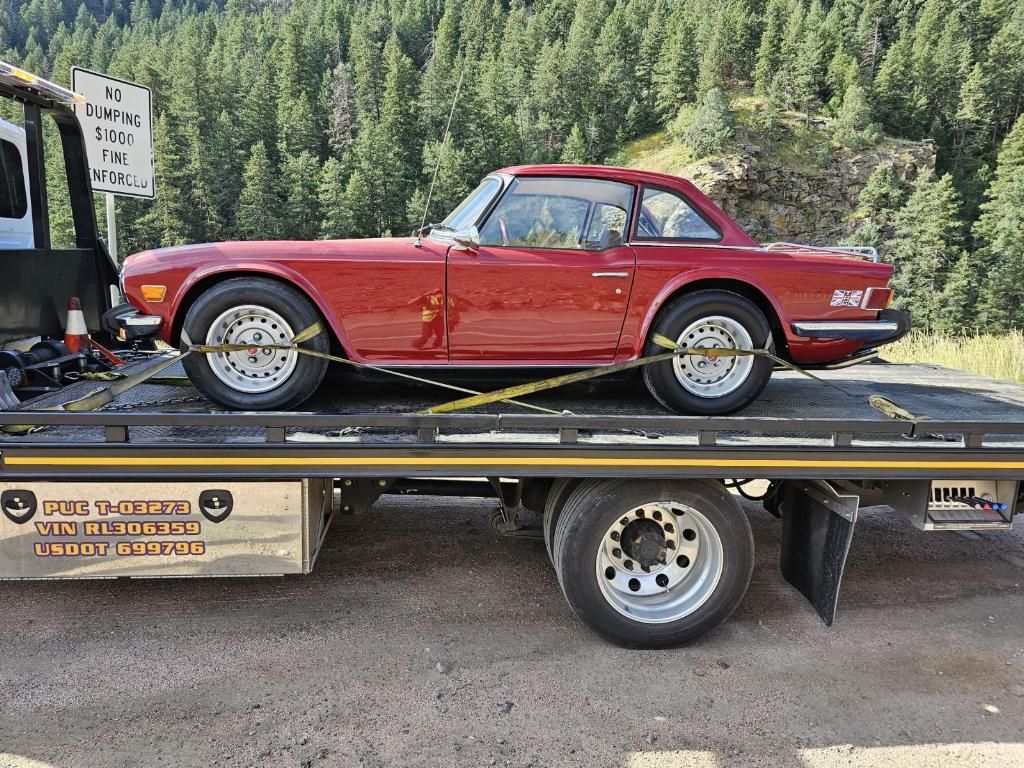
Once the truck is on scene, the hookup is where a tow either protects a vehicle or scuffs it. A light-duty flatbed load generally runs in this order, whether the car sits in a parking lot or at the bottom of a steep gravel drive.
The truck backs in square to the vehicle on the flattest ground available, so the car climbs straight instead of at an angle.
Drivetrain, ground clearance, the parking brake, and whether the car will go into neutral or tow mode all get checked before anything is attached.
The bed tilts and slides back until its tail meets the ground, forming the ramp. For a low car, a shallower angle matters more than speed.
The winch line attaches at a proper tow point, never a bumper cover or a suspension arm, and draws the vehicle up the bed with the wheels straight.
Each corner is strapped or chained to the bed so the vehicle cannot shift on a grade or a hard stop, then the bed levels out for the drive.
At your home or shop, the bed tilts again and the winch lets the vehicle roll back down under control, right where you want it parked.
D&J's crew includes WreckMaster and I-TECC certified professionals, and the company belongs to the Towing and Recovery Association of America and the Towing and Recovery Professionals of Colorado.
A car tow in a flat parking lot and a car tow at a foothill cabin are different jobs. These are the conditions our drivers plan around on everyday light-duty calls.
A low car parked on a steep drive meets the bed at a sharper angle. Tell dispatch where the car sits so the loading can be planned before the truck arrives.
A car on packed snow can slide sideways as the winch pulls. If it already slid off the road, it may need to be pulled back out before it can be loaded.
Narrow dirt roads with few turnarounds decide where the truck can stop. Mention tight turns, gates or low branches when you call.
On I-70, US 285 and CO 74, a quick, clean load gets your car and the truck out of fast traffic sooner.
"Absolutely fantastic! They rescued us off the side of I 70 during heavy traffic and made fantastic time doing it. The driver was incredibly friendly and professional with the car i call my baby. Strongly recommend this place."
Short answers to the questions dispatch hears most about everyday car, SUV and pickup tows. Anything else, ask when you call.
Passenger cars, crossovers, SUVs, minivans, half-ton pickups and small vans. Box trucks, buses and heavier work trucks move up to medium-duty or heavy-duty towing.
In most cases, yes. Most AWD owner's manuals require all four wheels off the ground, which means a flatbed or a wheel-lift with dollies. Tell dispatch the vehicle is AWD when you call.
It depends on the distance, the vehicle, how hard it is to reach and load, the time and road conditions, and the equipment the job needs. Call with the pickup and drop-off locations and dispatch will give you a quote.
Yes. Most electric vehicles ride on a flatbed with all four wheels off the road. Tell dispatch whether the screen still works and the car can be put in tow or transport mode.
D&J Towing accepts cash, Mastercard and Visa. If you are a AAA member, mention it when you call, since we serve AAA members.
Give dispatch the year, make and model, whether it is AWD, 4x4, electric or lowered, and where it needs to go. That is enough to send the right truck and quote the tow, any hour of the day.