24/7 dispatch
4.7681 Google reviews
WreckMaster and I-TECC certified
Family-owned in Evergreen
(303) 674-0198
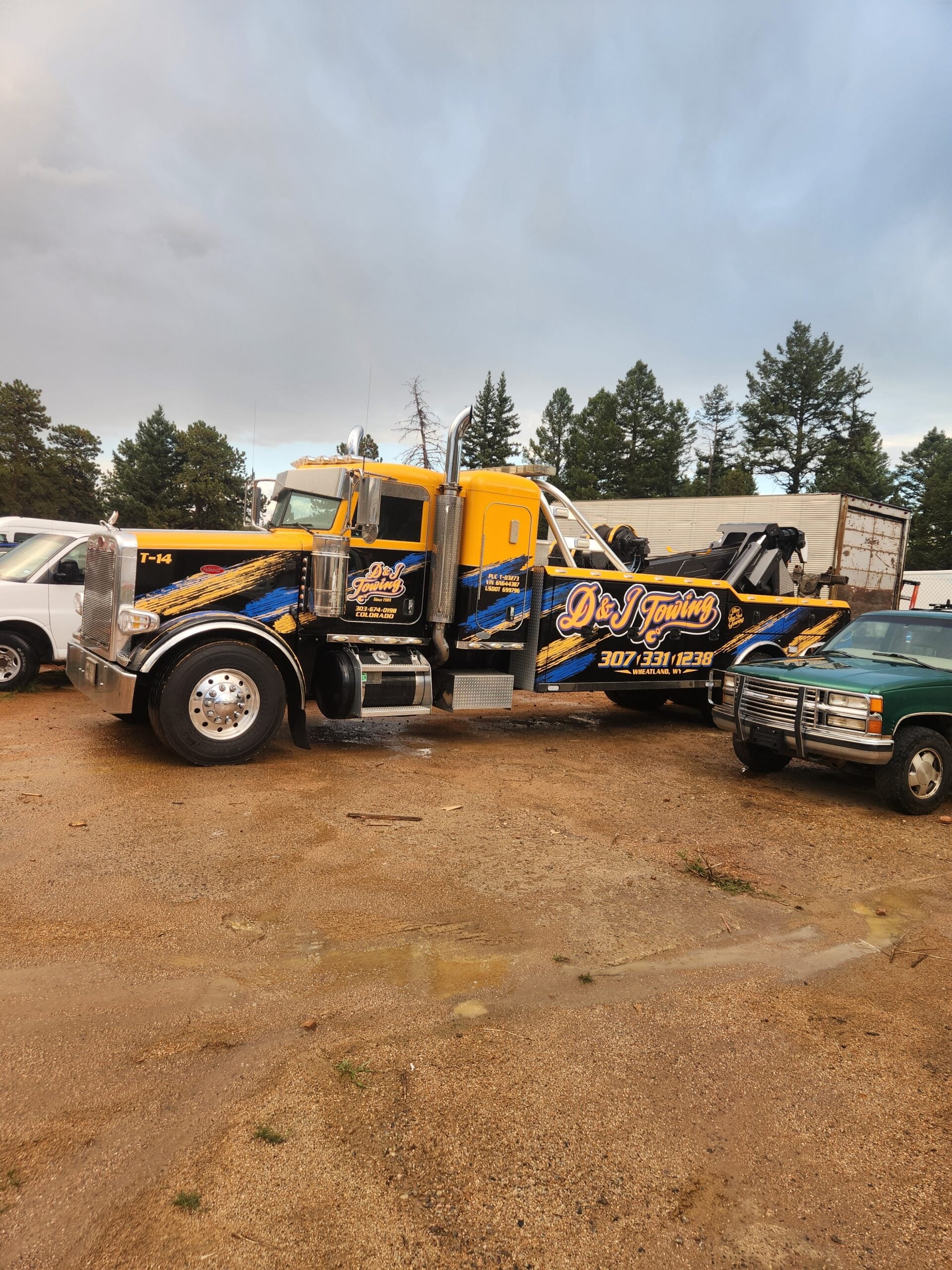
D&J Towing handles heavy-duty towing for Class 7 and 8 trucks, the tractor-trailers, dump trucks, buses and other big rigs a standard wrecker cannot move. One dispatch number covers I-70 and US 285 in the Colorado foothills and our heavy-duty work along the I-25 corridor in Wyoming, day or night.
 GVWR class7 and 8
D&J heavy wrecker, Evergreen
Federal weight classes put any truck rated over 26,000 pounds gross in heavy duty: Class 7 runs from 26,001 to 33,000 pounds and Class 8 is everything above that. A loaded tractor-trailer can weigh 80,000 pounds. These trucks stop on air brakes, ride on long wheelbases and carry drivetrains that can be wrecked by towing them the wrong way, so they need a heavy wrecker and an operator who knows how to rig them.
Tractor-trailers have their own page for semi truck towing. Vans, box trucks and service vehicles that run on business routes are covered under commercial vehicle towing. The calls below are the ones that need heavy gear on the hook.
Classes 3 to 6 are covered on our medium-duty towing page. FHWA weight classes as published by the U.S. Department of Energy. GVWR is the gross vehicle weight rating on the door plate.
Lost air, a blown engine or overheated brakes on a long climb or descent.
A truck and trailer that slid off in snow or folded on ice and has to be pulled back onto the road.
A damaged unit that cannot roll on its own and has to be recovered before it is towed.
A loaded truck sunk at a job site or ranch road. If it is a machine, see heavy equipment recovery.
A lot of winter heavy-duty calls start the same way: a truck loses traction on a climb and ends up across a lane or in the ditch. Colorado's commercial vehicle chain law sets what each rig must carry and when it must chain. Pick your rig and the level CDOT has posted.
1Your rig
2What is posted
When it is called: snow covers any part of the traveled pavement on an uphill grade.
Single drive axle, Level 1
Single drive axle combinations must chain all four drive wheels, and cables are not allowed. Every other commercial vehicle needs snow tires or chains.
Commercial chain law at a glance
| Rig | Level 1, Code 17 | Level 2, Code 18 |
|---|---|---|
| Single drive axle combination | Chain all four drive wheels, no cables | Chain four drive wheels |
| Tandem drive axle combination | Snow tires or chains | Chain four drive wheels |
| Other commercial vehicles | Snow tires or chains | Chain up; four or more drive wheels means chaining four |
| Buses | Snow tires or chains | Chain two drive wheels |
From September 1 to May 31, every commercial vehicle on I-70 between mile point 133 at Dotsero and mile point 259 at Morrison must carry enough chains to comply.
A car tow can take a few minutes on scene. A loaded heavy truck takes longer, because the truck has to be made safe to move before anyone lifts it. This is the order the job runs in.
Dispatch takes the unit and its configuration, whether it is loaded and with what, the location by mile marker and direction of travel, whether a lane is blocked, and where the truck needs to go.
The wrecker is placed to protect the work area, lights and cones go out, and on an interstate we work alongside whoever is controlling traffic.
A truck in the ditch, jackknifed or damaged in a crash is winched and brought back onto solid ground before any tow starts. The load decides how slowly that has to happen.
Spring brakes lock when a truck loses air, so they are released with air from the wrecker or caged before it moves. On most tows the driveshaft is disconnected so the transmission is not turned without oil moving through it.
The truck is lifted by the front axle or frame, or from the rear when the front end is damaged, and towed at a pace that suits the grade and the weather to the shop, dealer or terminal you choose.
Heavy work is quoted by the job, so there is no flat rate to post here. These are the things that move the number, and dispatch will ask about each one.
How far the wrecker travels to reach you, and how far the truck goes after it is hooked.
The weight class, and whether it is a tractor alone, a straight truck or a full combination with a trailer.
A loaded trailer is heavier and slower to handle, and a shifted or spilled load adds work on scene.
A truck sitting on the shoulder is a tow. A truck in the ditch, jackknifed or on its side is a recovery first.
Hours on scene, night work, snow and ice, and any lane closure the job has to work around.
Extra rigging, air supply and the steps it takes to make the truck safe to move.
Call with the unit, the load and the location and dispatch can quote the job. We take cash, Mastercard and Visa.
Get a quoteOut of Evergreen, our heavy-duty work runs on I-70 west of Morrison and US 285, where loaded trucks climb and descend for miles. Long grades are hard on brakes and engines, and winter adds ice, chain law closures and short daylight. Subzero mornings can gel diesel fuel and leave a truck dead at a chain-up area or a truck stop.
In Wyoming our work is heavy-duty and commercial, built around Wheatland and the I-25 corridor. Wind and snow on I-25 cause rollovers and breakdowns, and the long gaps between services there make a truck harder to reach. Both states run through the same dispatch number.
D&J Towing has been family-owned in Evergreen since 1984. Our crew includes WreckMaster and I-TECC certified professionals, trained in rigging and recovery, the parts of a heavy tow where mistakes cost the most.
"D&J pulled my jackknifed truck and trailer out of a snowy ditch and got us down the hill safely. They were fast, easy to work with, up for a challenge and very friendly and helpful. 10/10 would be towed by them again if needed!"
Fleet managers and drivers ask us these most often. Anything else, call dispatch and ask.
Any truck in federal weight Class 7 or 8, which means a gross vehicle weight rating over 26,000 pounds. That covers tractor-trailers, dump trucks, garbage trucks, concrete mixers and large buses.
It depends on the distance, the size and setup of the truck, whether it is loaded, whether it needs recovery before the tow, the time and conditions on scene, and the equipment the job takes. Call with the details and dispatch can quote it. We take cash, Mastercard and Visa.
Yes. Our Wyoming work is heavy-duty and commercial towing, recovery and hauling, built around Wheatland and the I-25 corridor. The same number, (303) 674-0198, reaches dispatch for both states.
Accident recovery and winch-outs are part of our work, and a truck that is off the road is recovered before it is towed. Tell dispatch how the truck is sitting, whether the trailer is still attached and whether the load is still on board, so we can plan the job before we arrive.
Get clear of traffic and call 911 first if anyone is hurt or a lane is blocked. Set warning devices only if it is safe to do so; federal rules call for them within 10 minutes of stopping. Then call us with the mile marker and direction of travel.
Give us the unit, the load and the mile marker, and we will plan the tow before the wrecker leaves. If you are not sure which service fits, start with our full list of towing and recovery services, or just call and ask.