Heavy equipment recovery for stuck and tipped machines
Heavy equipment recovery is the work of getting a stuck, mired or tipped machine back on solid ground without anyone getting hurt and without adding damage. D&J Towing takes these calls 24 hours a day from job sites, ranches and driveways across the foothills, and the first step is the same every time: tell dispatch what the machine is and how it is sitting.
Pick the position that matches what you see. The checklist beside it covers the hazards to look for before the truck arrives, and the last line is what to say when you call. Tap each item as you check it.
Machine attitudePick one
Upright, stuckTop side up, wheels or tracks down
Upright, stuckOn its sideOn its roofNose down
Upright, stuck
Mired in mud, snow or soft fill
The machine is on its tracks or wheels but sunk past the point where it can drive out. It is usually the simplest equipment recovery, as long as nobody makes the hole deeper first.
Stop spinning it. Every pass of the tracks or tires digs it deeper and adds suction.
Bucket or blade down, brake set, engine off. That is how OSHA's construction rule says idle equipment should sit.
No chain pulls with another machine. A strap or chain that lets go under load can whip back hard.
Note how deep it sits and what is under it: mud, snow, soft fill or thawing ground.
0 of 4 checked
Tell dispatch"Upright and stuck, sunk about to the (tracks, axles, frame), ground is (mud, snow, fill)."
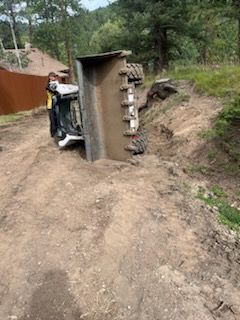
On its side
Rolled over onto one side
A machine on its side is resting on parts that were never built to hold it, and it can still shift. Uprighting it is a controlled job with lines on both sides of the roll.
Operator out and checked. Any injury, call 911 first.
Nobody on it, under it or downhill of it. Leave it exactly as it lies.
Look up. Treat any power line overhead as live and keep people well back.
Watch for leaks of fuel, oil or hydraulic fluid. Never feel for a hydraulic leak by hand.
0 of 4 checked
Tell dispatch"On its (left, right) side, on (flat ground, a slope), fluids (leaking, not leaking), power lines (yes, no)."
On its roof
Upside down on the cab or ROPS
An inverted machine carries its full weight on the cab or rollover frame, and fluids start draining the wrong way. It gets rolled back in stages, not flipped in one pull.
People first. Anyone trapped or hurt means 911 before anything else.
Do not reach or crawl under it. Nothing is blocking it from settling further.
No smoking, no sparks nearby. Fuel and oil are likely seeping out.
Note any attachment still on: bucket, forks, breaker, mower deck.
0 of 4 checked
Tell dispatch"Upside down, attachment (on, off), fluids (leaking, not leaking), everyone is out and accounted for."
Nose down
Pointed down a slope or bank
The machine slid or drove over an edge and is hanging front-first down the grade. Often the bucket or boom dug in and is what is holding it, so it has to stay put.
Do not raise the bucket or boom. If it is planted, it is acting as the anchor.
Nobody below it. Clear the downhill side completely.
Do not try to back it up the grade. Slipping tracks can turn a slide into a roll.
Note what is below: a creek, a road, a foundation, a drop.
0 of 4 checked
Tell dispatch"Nose down on a (gentle, steep) slope, bucket (planted, up), (creek, road, structure) below, a truck can reach it from (above, below)."
MM02Machine types
Each machine gets stuck its own way
The machine decides where rigging can attach, which way it wants to roll and what has to come off before it moves. Here is what dispatch listens for with four common machine types.
E-01
Excavators
Mini to full-size. On a slope, swinging a loaded bucket downhill moves the weight that keeps the tracks planted. In mud, a tracked machine can belly out until the undercarriage carries it.
Dispatch needsMake, model, size class, attachment on, and where the boom is resting.
E-02
Skid steers
Wheeled skid steers and compact track loaders are short and heavy, so a raised load on a side hill tips them quickly. Tracked units sink in snowmelt mud more than people expect.
Dispatch needsWheels or tracks, the attachment, and whether the lift arms are up or down.
E-03
Loaders and backhoes
Wheel loaders and backhoe loaders are taller and longer, and an articulated loader can jackknife as it goes over. Both carry a lot of weight in the bucket end.
Dispatch needsModel, whether the bucket is loaded, and if it is bent at the frame joint.
E-04
Tractors
Ranch and farm tractors get into trouble on ditch banks, wet hay ground and steep pasture, often with an implement still hitched behind them.
Dispatch needsMake and model, any front loader, the hitched implement, and the gate or road in.
Othermachines
Dozers, forklifts, telehandlers, trenchers, rollers and anything else with tracks or tires: describe it and dispatch will tell you straight whether it is a job for our trucks. If the machine also needs to go somewhere afterward, we can plan the haul on the same call.
MM03Before you call
Six details that decide what truck comes
An equipment recovery is planned on the phone before it is worked on the ground. The right answers to six questions tell dispatch what kind of truck and rigging to send, and which way the pull should go.
The weight is the one people guess at. Look on the machine's data plate, the operator's manual or the spec sheet, or ask the rental yard if it is a rental. Add the attachment and any load in the bucket.
Not sure of a detail? Call anyway. Dispatch will walk you through what to look for while you stand next to the machine.
Recovery data plate
Make and modelTells us the machine's shape, balance and where it can be rigged.
Approximate weightMachine plus attachment plus anything in the bucket.
PositionUpright and stuck, on its side, on its roof or nose down.
GroundMud, snow, frozen, loose fill, rock, and how steep.
AccessHow close a truck can get, gates, grades, overhead lines.
FluidsFuel, oil or hydraulic fluid leaking, and how much.
MM04How it works
How an equipment recovery is worked
Every site is different, but the order stays the same. The slow part is the planning, and that is on purpose: a machine that moves the wrong way during a pull is how a recovery turns into a second accident.
StepPhaseWhat happensWhat protects the machine
W-01
Size up
What happensThe operator walks the machine, the ground, the slope and the area overhead, and picks the direction of pull.
ProtectsNothing is hooked until the plan accounts for where the machine will go when it moves.
W-02
Stabilize
What happensThe machine is kept from sliding or settling further, and leaks are contained where they can be.
ProtectsStops a bad position from getting worse while the rigging goes on.
W-03
Rig
What happensStraps or chains go on solid points built to take load, such as frame tie-downs or lift points.
ProtectsNever hooked to hoses, cylinders, glass or the cab, and padded at sharp edges.
W-04
Pull or upright
What happensA slow, steady pull, with a second line holding back the other side when a machine is being rolled over.
ProtectsThe control line keeps it from slamming down onto its tracks or tires.
W-05
Check and move
What happensOnce it is on solid ground, the machine is looked over before anyone starts it, and you decide whether it drives off or gets hauled.
ProtectsA machine that sat on its side or roof can have oil where it should not be, so it gets checked before it runs.
MM05While you wait
Three safety rules that apply on any site
A stuck machine is rarely an emergency. A tipped one can be, mostly because of what people do in the first few minutes: climbing on it, reaching under it, or trying to drive it out. Keep the crew back, keep the area quiet, and let the recovery start from a machine that has not moved since it went over.
These three points come straight from federal and agricultural safety guidance.
If anyone is hurt or trapped, or a machine is touching a power line, call 911 first. Then call us.
DOWN
Lower it, block it, or stay out from under it
OSHA's construction equipment rule says buckets, blades and dump bodies are to be fully lowered or blocked when not in use, and that machinery held up by slings, hoists or jacks must be blocked or cribbed before anyone works under it.
OSHA's crane and derrick rule tells employers to assume all power lines are energized and sets a minimum clearance of 10 feet for lines up to 50 kV. If a tipped machine or its boom is near a line, stay well clear and call the utility.
Hydraulic systems can run at 1,000 to 3,000 psi, enough to push fluid through skin. Agricultural safety guidance says to never use your hand to check for a leak and to pass a piece of cardboard over the area instead. An injection injury needs immediate medical care.
There is no flat rate for pulling a machine out, because no two sites are the same. Dispatch can talk you through the job once it knows the details. These are the things that move the price:
The machine's size and weight
How it is sitting: stuck, side, roof or nose down
Ground and slope at the site
Distance from Evergreen and road access
How much rigging and time the pull takes
Night, weekend or storm conditions
D&J Towing has worked the Colorado foothills and Denver metro since 1984, and our operators include WreckMaster and I-TECC certified professionals. We take cash, Mastercard and Visa.
Not sure if your machine is a job for us? Call dispatch with the make, model and weight and you will get a straight answer.
Can you recover a tipped excavator or skid steer?
Yes, heavy equipment recovery is one of our services. Whether a particular machine is a fit depends on its size, weight and where it is sitting, so call with the make, model and position and dispatch will tell you before anyone heads out.
What should my crew do while we wait?
Shut the machine down, keep everyone off it, out from under it and away from the downhill side, and stop trying to drive or pull it out. Note any leaks and any power lines overhead, and clear a path for the truck if you can.
How much does heavy equipment recovery cost?
It depends on the machine's size and weight, how it is sitting, the ground and slope, how far the site is and how hard it is to reach, the rigging and time involved, and the conditions. Call dispatch with those details to talk through your job.
Can you haul the machine away after the recovery?
Yes. D&J also does equipment hauling, so a machine that should not be driven after a rollover can be loaded and moved to your yard, a dealer or a repair shop. Mention it on the first call so both jobs get planned together.
Do you take equipment calls at night and in Wyoming?
Dispatch answers 24 hours a day, every day of the year. We serve the Colorado foothills and Denver metro around Evergreen, and we are growing heavy-duty towing, recovery and hauling around Wheatland, Wyoming and along the I-25 corridor.
Machine stuck or over? Call before it moves.
Have the make, model, rough weight and position ready, plus how a truck gets in. Dispatch will plan the pull with you on the phone, day or night.