24/7 dispatch
4.7681 Google reviews
WreckMaster and I-TECC certified
Family-owned in Evergreen
(303) 674-0198
D&J Towing runs 24/7 emergency towing for cars, trucks and commercial vehicles that break down or crash on Colorado foothill roads. One call reaches dispatch at any hour, weekends and holidays included, and a truck matched to your vehicle heads your way.
Usually, yes: buckled in with the hazard lights on is the safest place to wait. Not every stop allows it. Answer three questions about where you are and the panel shows what general roadside safety guidance says for that spot.
Where did the vehicle stop?
Is there a safe spot away from traffic?
Behind a guardrail, up an embankment, or well off the pavement, reachable from the side of the car away from traffic.
Conditions right now
General roadside safety guidance only. If you are ever unsure, keep your seat belt on and call 911.
Find the situation that matches yours in the panel beside this one. When in doubt, stay buckled in with the hazards on and call.
Dark or bad weather: passing drivers see you later, so keep the hazards on the whole time. If you stay inside and run the engine for heat, keep the tailpipe clear of snow so exhaust cannot build up in the car.
Call dispatch nowIf the vehicle cannot move safely under its own power and waiting until morning is not an option, it is an emergency tow. These are the calls that come in at all hours.
The engine quits on an interstate, an on-ramp or a two-lane highway with no room to sit. Getting the vehicle off the road fast is the whole job.
A vehicle that cannot be driven after a collision goes to a body shop, your home or our approved storage yard. Rollovers and vehicles off the road fall under accident recovery.
Long mountain grades are hard on cooling systems and brakes. If the temperature gauge climbs or the brake pedal goes soft, stop driving and call.
Stuck in a dark pull-off, a trailhead lot or a parking garage at night. If a jump or a new battery would fix it, roadside assistance can get you rolling without a tow.
A slide into a ditch or snowbank often needs a winch-out first. If the vehicle cannot be driven once it is back on the road, it rides out on the truck.
Box trucks, buses, work trucks and semis down on a highway. Light-, medium- and heavy-duty towing all run around the clock.
Most emergency tows follow the same five steps. Knowing them ahead of time tells you what to expect while you wait.
Tell us where you are (road, direction, mile marker, exit or landmark), what you drive, whether it rolls and steers, where it should go, and whether anyone is hurt.
Dispatch quotes the job on the phone and sends the truck that fits your vehicle and the spot it is in.
The operator places the truck to shield the work area, lights it up, and checks how your vehicle is sitting before anything gets hooked.
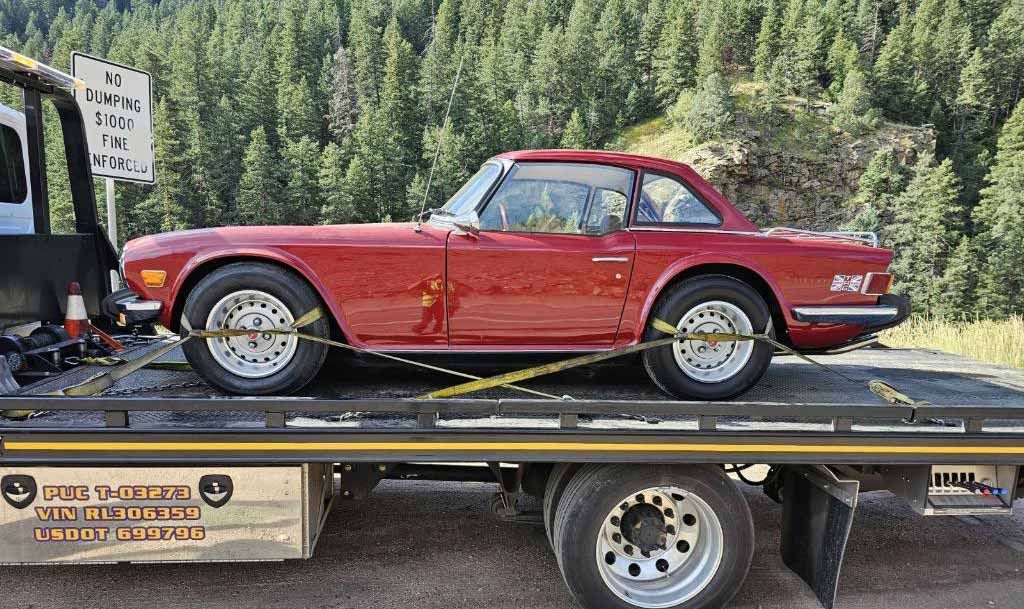
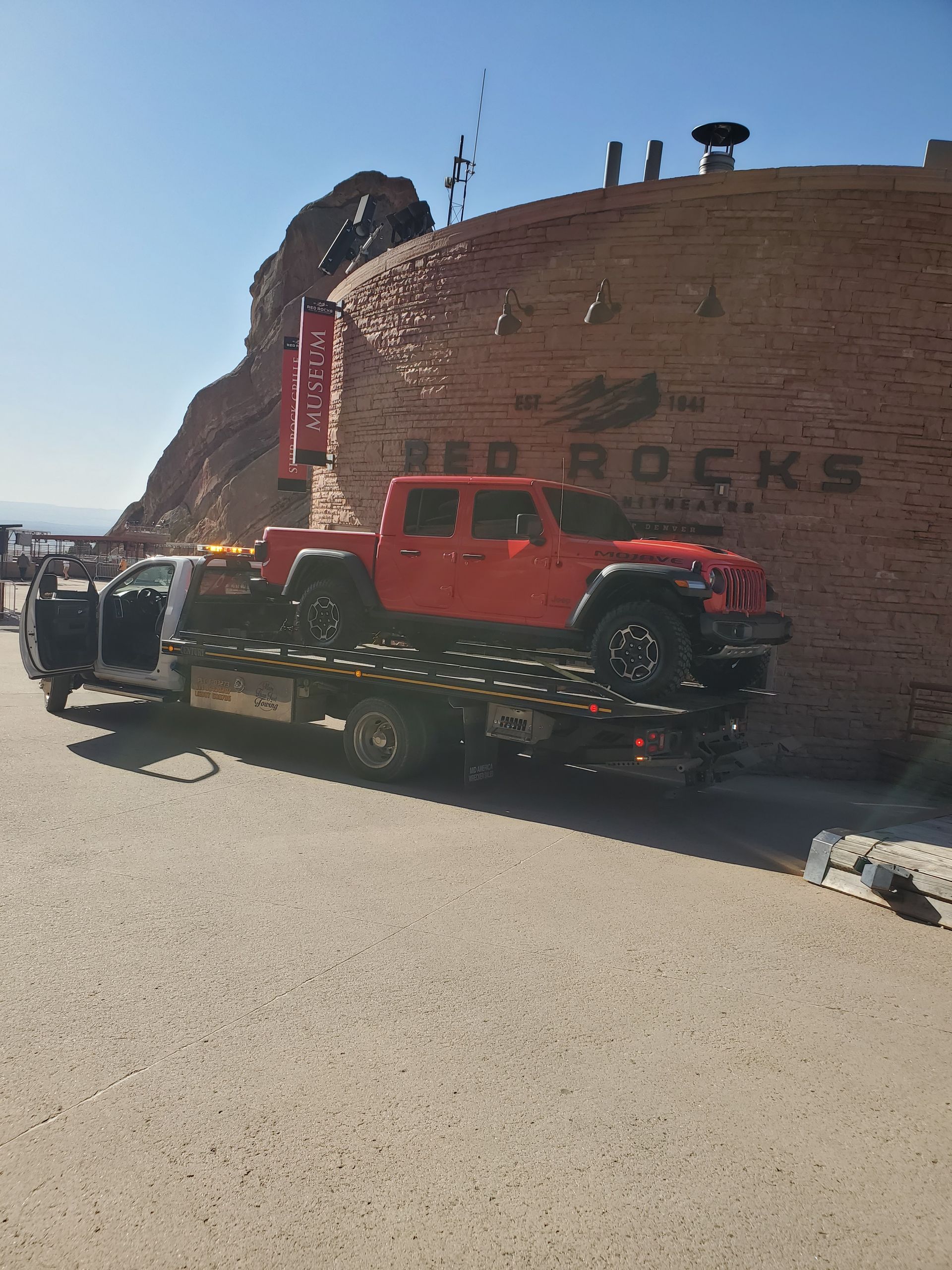
On a flatbed tow, the vehicle is winched onto the bed and strapped down at four points so it rides without rolling.
To your home, the repair shop you pick, or our approved storage yard in Evergreen after an accident. We take cash, Mastercard and Visa.
The vehicle, where it is sitting and what shape it is in decide the truck. The same things, plus distance and time, decide how much a tow costs.
Cars, SUVs, AWD and 4x4 vehicles, low cars, classics, and anything that should not roll on its own wheels. The whole vehicle rides on the bed.
Vehicles that have to be pulled out of a ditch, off an embankment or out of a tight spot before they can be towed.
Box trucks, buses, work trucks, semis and other commercial units, loaded or empty.
How pricing works
There is no flat price for an emergency tow. Ask dispatch for a quote when you call. These five things set the number.
A breakdown in a flat suburb and a breakdown on a canyon curve are different calls. D&J has worked these roads out of Evergreen since 1984, and our drivers plan the hookup around the road as much as the vehicle.
Fast traffic and short merges leave little room, so clearing the vehicle quickly keeps everyone safer.
On US 285 and CO 74, a breakdown can leave you half in the lane on a curve, the exact case where the safety panel above says to call 911.
Drivers must move over a lane, or slow down well below the limit, for any vehicle stopped with its hazard lights flashing. That covers your car and our tow truck.
"Wow!!! Incredibly fast and friendly service. I was super stuck. And D&J bailed me out! Steve (driver), was fast and fearless! Hooking a car on an interstate on ramp is not for the faint of heart. Dispatch was efficient and I only paid what I was quoted. If you ever need a mountain based tow, call D&J!!!"
Short answers to the questions dispatch hears most on emergency calls. Anything else, ask when you call.
Yes. D&J Towing is open 24 hours a day, 7 days a week, 365 days a year, holidays included. The same number, (303) 674-0198, reaches dispatch at any hour.
It depends on the distance, the size and class of the vehicle, how hard the recovery is, the time and road conditions, and the equipment the job needs. Ask dispatch for a quote over the phone.
Yes. D&J Towing serves AAA members. If you carry an auto club plan, mention it when you call.
To your home, the repair shop you choose, or, after an accident, our approved storage yard in Evergreen. Tell dispatch the destination when you call so the quote covers the full trip.
In most cases, yes, with your seat belt on and the hazard lights flashing. If the vehicle cannot get out of the flow of traffic and there is a safe place behind a guardrail or up an embankment, exit on the side away from traffic and wait there. If there is smoke, fire or an injury, call 911 first.
Tell dispatch where you are and what you drive, and stay buckled in while the truck is on the way.